Ensuring better patient outcomes through precise dose calculation
Neurologists often under-dosed complex indications like spasticity, wary of adverse effects and without an accessible way to calculate a confident, correct dose. I led the initial design of OnADose, the app AbbVie built to change that, and it cut dose-calculation time by 32% while growing monthly active users by 9% in its first year.
Dosing without guardrails
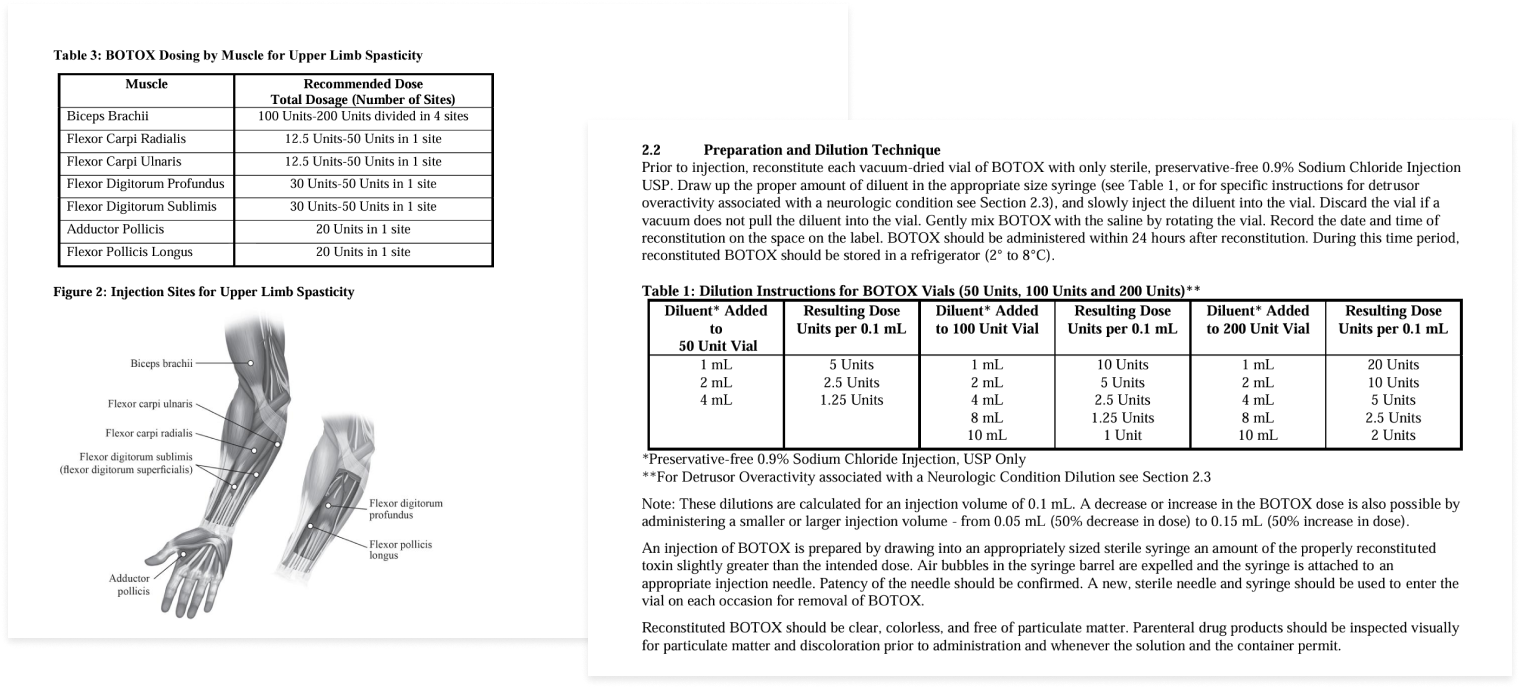
To calculate a dose, a physician works from the Prescribing Information, Botox's source of truth for dosing guidance: dense reference tables for dilution, injection sites, and recommended units by muscle. Manual calculation from that document increases the risk of inconsistency, and clinical inertia without guardrails to catch errors can lead to suboptimal patient outcomes.
Physicians don't dose alike, either. Experience varied widely, and the project landed amid COVID-19, when even routine variables like needle availability were unpredictable due to supply chain issues. AbbVie's medical affairs team had seen from real-world studies and EHR records that many indications were under-dosed simply because physicians lacked awareness of effective treatment options, not because the information didn't exist. The PI would remain the source of truth; the app needed to make it usable.
The Prescribing Information already broke dosing into the same shape for every indication: muscles, vials, dilution, syringes. Once that structure was built into the interface, OnADose could turn a dense reference document into a guided flow instead of a manual lookup.
What we were designing around
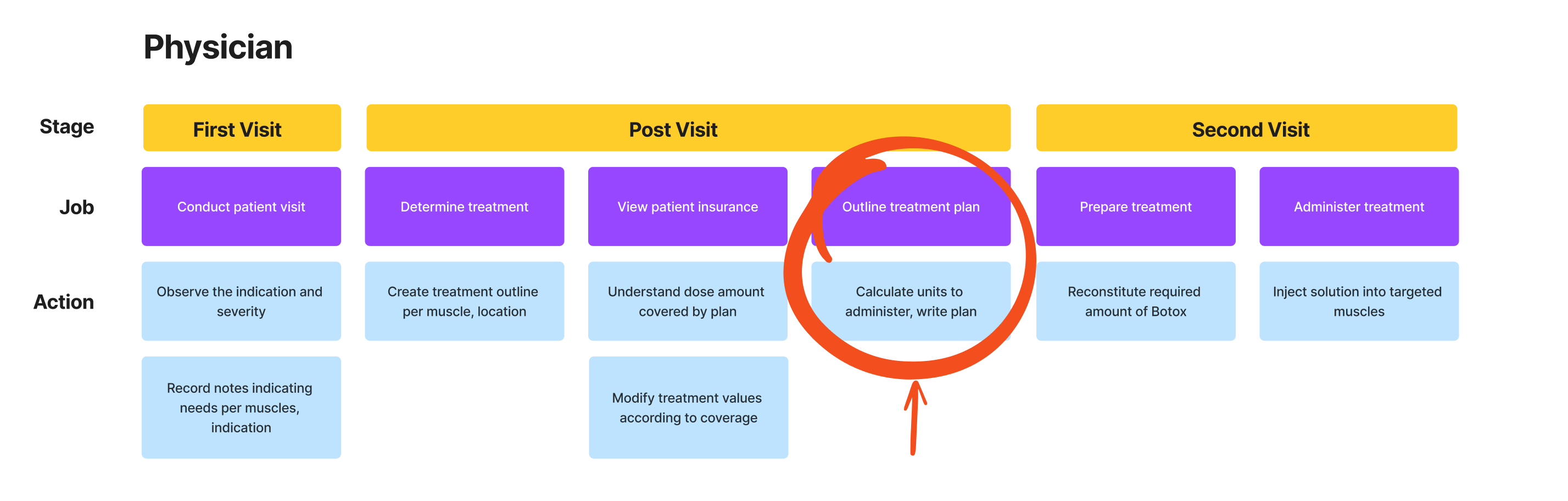
Stakeholder and subject-matter-expert interviews grounded the work in the actual Prescribing Information. Physician interviews and experience mapping then showed where the real friction lived: calculating units and writing the treatment plan, buried in the post-visit stage between determining treatment and preparing it.
Selecting, dosing, and preparing
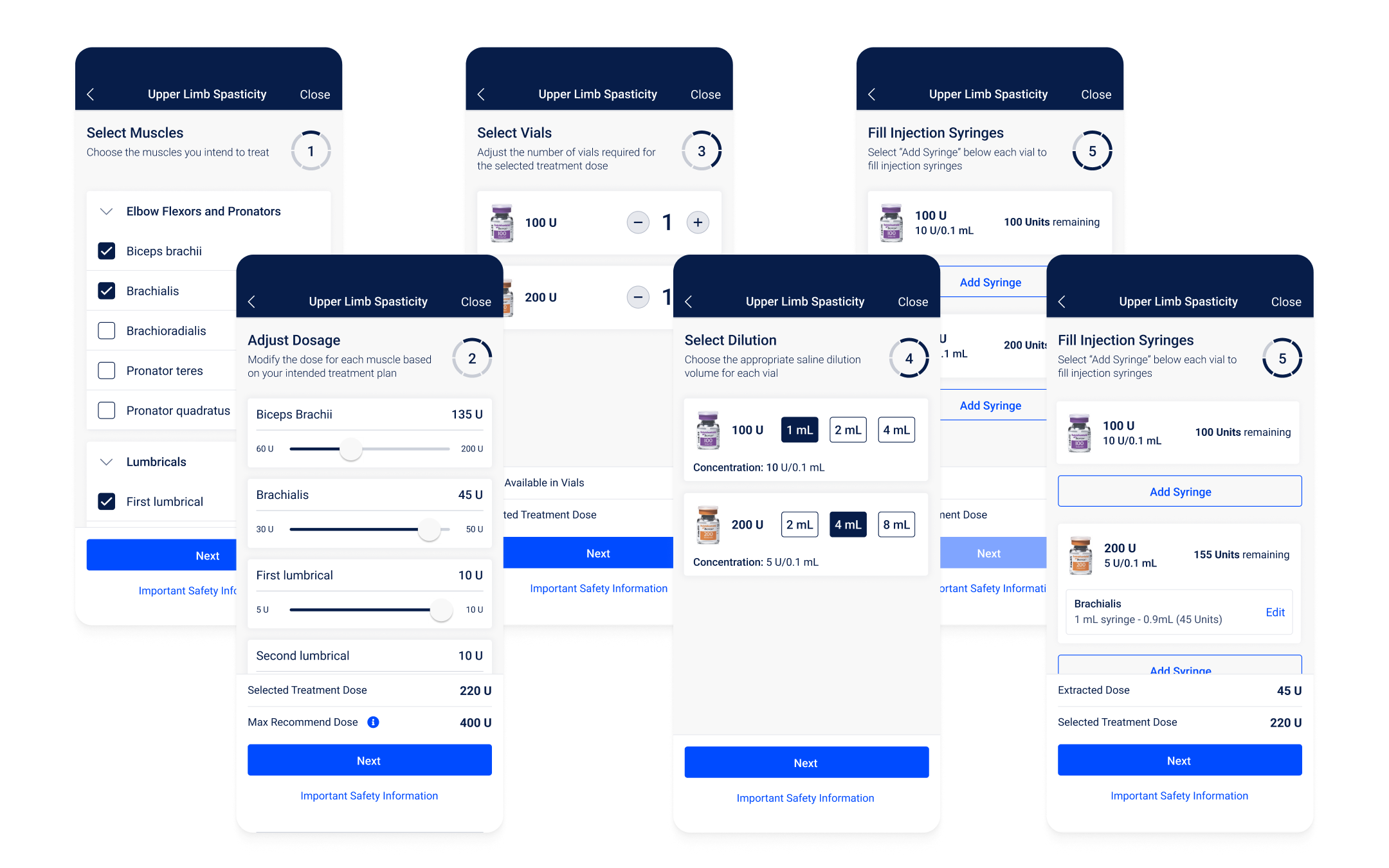
Select the muscles being treated, adjust dosage per muscle against the recommended range, select vials, choose a dilution, then fill and review each syringe before treatment. Removing the manual math didn't just save time, it removed a place errors could hide.
Testing the direction early
Immediately after discovery, I built a low-fidelity prototype to test a hypothesis for the proposed direction, working with the product owner from the insights in my interviews. Follow-up calls with physicians to review it surfaced additional professional practices that changed how we configured dose ranges, before any visual design work began.
The shipped app
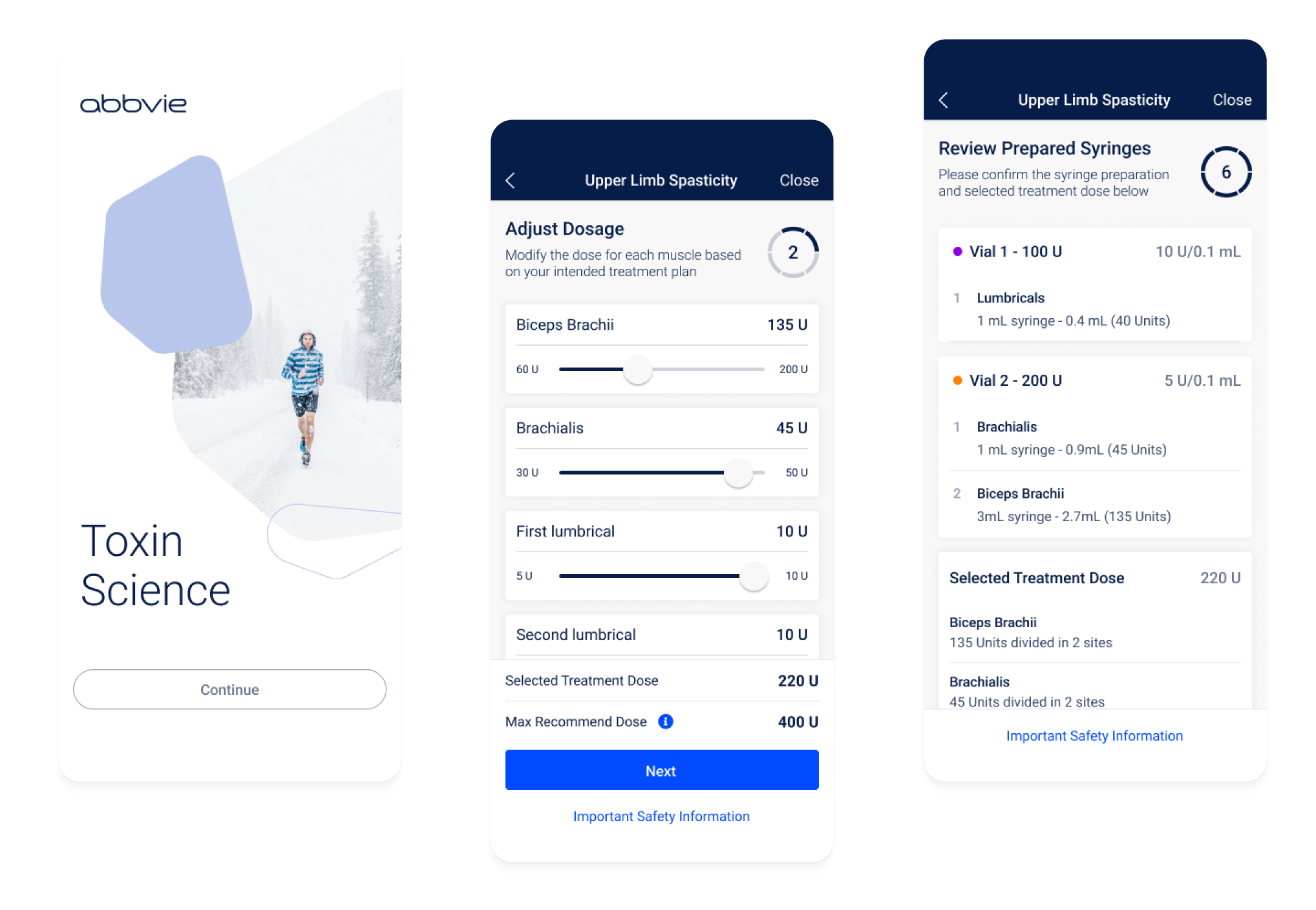
Leveraging AbbVie's brand standards, I explored a few directions before landing on the one that shipped, delivering the visual and interaction design for both iOS and Android in React Native in four months.
Impact
OnADose launched to neurologists and care teams in December 2022. With no marketing budget to drive exposure, usage has grown steadily through word of mouth among neurologists.
- 32% reduction in total calculation time (as of April 2023)
- 9% average increase in monthly active users
One neurologist said the app has helped bridge the gap between knowledge and application when training residents and fellows, evidence the tool changed practice, not just paperwork.
Accomplishments
- Delivered visual and interaction design for iOS and Android in React Native in four months.
- Simplified dosing into a guided flow that removed the need for manual calculation.
- Shortened prep time for patient visits, contributing to faster, more confident treatment planning.
- Ran stakeholder, SME, and physician interviews, plus experience mapping, to scope and validate the design direction.
Reflection
OnADose is a simple app on its surface, but the pharmaceutical industry's insistence on rigorous, standardized documentation turned out to be a gift, not a constraint. The Prescribing Information already gave every indication the same underlying structure of muscles, vials, and dilution, so once that structure was built into the interface, adding a new indication became a matter of formatting, not redesigning. The lesson was that a heavily regulated domain's own rigor can double as your information architecture, if you're willing to build around it instead of working against it.